Petition Counters cookie and public health
Petition Counters cookie Linky and public health
Monday, February 14, 2011
Thursday, February 10, 2011
Bud Vases With Suction Cup
you forgetting or Not To Be
Forgetting evokes an inevitable phenomenon, a kind of natural degradation of memory as the erosion that would erase the traces on the sand. While memory seems to be the clean living, a courageous effort against nature, is associated rather oblivion to the world of inert in nature reasserts itself after death. The analogy is tempting but misleading. I had already told in this previous post about the blackouts how oblivion is a more subtle than that. Not only can you forget to order but we especially oblivion is useful to adapt to change, we avoid the white front of the ATM when our PIN has changed. At random from my reading I discovered many other situations where oblivion is being an assistant to both small and precious our memory ...
The Babel of chattering
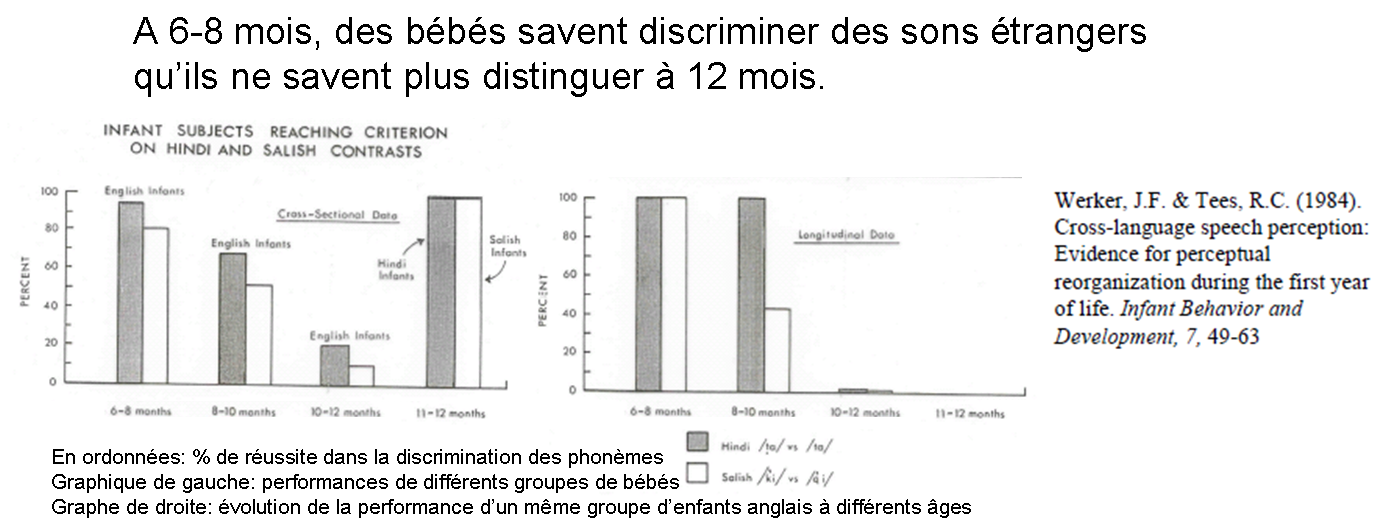
Before the 1970s, it was thought that a baby was learning his mother tongue from a blank page, and it was only by dint of drive that succeeded his ear to recognize a particular sound. Yet it was realized that at the age of one month a baby can distinguish sounds very similar like "ba" or "pa". And then, in 1985 it was discovered that six months of English could make babies the difference between foreign phonemes (the Ta 'retroflex' and your 'no retroflex' in Hindi, or two phonemes ki / qi equally exotic language Salish ) that an adult can not even distinguish ! This ability decreases with age and disappears at about 12 months: the exact opposite of what we expected:
Contrary to what one might have thought, a So baby would be born with an innate ability to distinguish a wide range of phonemes, a kind of universal grammar common to all languages. Learning a language the paradoxically forced to "forget" all the sounds are not material to better focus on those that are relevant. At six months are unusual vowels through the cracks and one year is the turn of the consonants. Gradually the intricacies of other languages disappear from his ear and his small inner tower of Babel is volatilized gradually. Once adult Spaniards do not distinguish v a b or u a or that the French do not understand the different r Dutch, the Japanese confuse the and r , the Germans do not distinguish between b and p, s and z etc.. The word "barbarian " does it not for the Greeks all who spoke by onomatopoeia "bar-bar-bar"?
They all look alike!
The same phenomenon of unlearning is at work as regards the recognition of faces.
Why do we confuse the faces of Asians or Africans? This difficulty in recognizing facies other ethnic groups is not related to our prejudices or our unwillingness but is common among all people: for a Chinese, all European faces are identical. But this is not innate indiscrimination: the infants three months are quite gifted to distinguish the features of a variety of African faces, Chinese, European or Middle East . As they grow, infants focus on the types of faces they are frequently exposed and lose their ability to differentiate between other ethnic groups. At nine months the children have been unable to distinguish faces that are not European. This strange unlearning is the price to pay to recognize very quickly members of his own ethnicity and to focus its identification capabilities. As for foreign languages which are no longer able to perceive the subtleties, mentally put away the faces of other ethnic groups in the category "not home", without being able to distinguish them from each other.
Forget the left-right symmetry to read
We are wired for assimilate an object to its mirror image because apart from the crescent moon whose orientation indicates whether it is increasing or decreasing, most natural objects appear in their profile either right or left. It reason advanced by Stanislas Dehaene to explain why children who learn to write often tend to draw their letters in reverse, as in a mirror, confounding the b and of the p and q . To learn to read and write, then, must also unlearn regarded as equivalent to the left and right ...
Forget learned!
Learning to live is also able to overcome his fears and anxieties, know how to forget a scary bark, a heartache or a big scare in bicycle. How a memory fades from our memory is again quite different from what one might think intuitively.
If you train a rats to fear a particular sound by administering a small electric shock every time he hears it, you can pretty easily "deconditioning" by exposing it to sound without shock, or better by involving the food. After a moment, his most frightens our friend the rat. The initial conditioning was it forgotten? Not all of course: it is the galloping so long after you associate with new voters in his shock. The packaging was simply hidden, ready to resume service at the slightest alarm. The observation confirms his little brain after deconditioning original fear is ever present (the amygdala in the brain, remember? We talked about in this post ), but it is inhibited by another area brain (prefrontal cortex). What we take for oblivion is actually a new learning that restrains the first reflex behavior. Moreover, in case of injury in the prefrontal area, the animal remains quite capable of learning a new fear conditioning, but it is much more difficult to unpack.
Same with us humans: we do not forget a traumatic experience by erasing its traces in our heads as if it were a slate. Such memory is not forgotten, he tamed at most. For he lost some of its emotional charge and stop us scratching we must learn to associate with other experiences, positive or neutral: back in the saddle immediately after his fall back on the scene of a personal tragedy , talk about what has hurt us so. Well, I do most of these famous mock 'Cells of counseling "that deploys all emergency when there is a disaster somewhere ...
Not easy to forget in the depths of his brain ...
You've probably been trying to guess the object that was removed from a room or a table that you have observed well in advance? And even if you do not know the answer, your eyes will face longer subconsciously at the location of the missing object. was experienced with volunteers who
we presented 216 photographs of faces in front of a landscape. Then participants were asked to choose among three faces, which they had seen the face of this landscape. As they reflected, the researchers analyzed the direction of their gaze and found that when looking at the right place, the hippocampus (the small area of the brain responsible for memory) cell now busily accurate, even if they eventually opted for a bad choice thereafter. They concluded that the memory was indeed present physiologically, but insufficiently strong to awaken the conscience and make the right choice.
Forgetting therefore mean sometimes hide, suppress memories, sometimes lose access to consciousness. Similarly "erasing" a computer file does not erase all the bits that compose it but remove the index used to find them and put them in the correct order. As the experts come to get some files deleted by mistake or malice, sometimes a profound stimulation of certain areas the brain makes memories resurface strongly that we had completely forgotten. Strange creature that definitely oblivion: it hides there in infants, when there's nothing to think and forget where it eludes memory just seems to be lacking. Homer Simpson, a great connoisseur of the human soul, was right: forgetting is essential to learn:
Related posts
Absences are always right: on blackouts
Man beta : Technology and the man who makes that?
Viewpoints : what happens when we look eye to eye ...
Forgetting evokes an inevitable phenomenon, a kind of natural degradation of memory as the erosion that would erase the traces on the sand. While memory seems to be the clean living, a courageous effort against nature, is associated rather oblivion to the world of inert in nature reasserts itself after death. The analogy is tempting but misleading. I had already told in this previous post about the blackouts how oblivion is a more subtle than that. Not only can you forget to order but we especially oblivion is useful to adapt to change, we avoid the white front of the ATM when our PIN has changed. At random from my reading I discovered many other situations where oblivion is being an assistant to both small and precious our memory ... The Babel of chattering
Before the 1970s, it was thought that a baby was learning his mother tongue from a blank page, and it was only by dint of drive that succeeded his ear to recognize a particular sound. Yet it was realized that at the age of one month a baby can distinguish sounds very similar like "ba" or "pa". And then, in 1985 it was discovered that six months of English could make babies the difference between foreign phonemes (the Ta 'retroflex' and your 'no retroflex' in Hindi, or two phonemes ki / qi equally exotic language Salish ) that an adult can not even distinguish ! This ability decreases with age and disappears at about 12 months: the exact opposite of what we expected:
Contrary to what one might have thought, a So baby would be born with an innate ability to distinguish a wide range of phonemes, a kind of universal grammar common to all languages. Learning a language the paradoxically forced to "forget" all the sounds are not material to better focus on those that are relevant. At six months are unusual vowels through the cracks and one year is the turn of the consonants. Gradually the intricacies of other languages disappear from his ear and his small inner tower of Babel is volatilized gradually. Once adult Spaniards do not distinguish v a b or u a or that the French do not understand the different r Dutch, the Japanese confuse the and r , the Germans do not distinguish between b and p, s and z etc.. The word "barbarian " does it not for the Greeks all who spoke by onomatopoeia "bar-bar-bar"?
They all look alike!
The same phenomenon of unlearning is at work as regards the recognition of faces.
|
| The faces used in the test (source here ) |
Forget the left-right symmetry to read
| |
| The mirroring (source here ) |
Forget learned!
Learning to live is also able to overcome his fears and anxieties, know how to forget a scary bark, a heartache or a big scare in bicycle. How a memory fades from our memory is again quite different from what one might think intuitively.
| |
| (source here ) |
Same with us humans: we do not forget a traumatic experience by erasing its traces in our heads as if it were a slate. Such memory is not forgotten, he tamed at most. For he lost some of its emotional charge and stop us scratching we must learn to associate with other experiences, positive or neutral: back in the saddle immediately after his fall back on the scene of a personal tragedy , talk about what has hurt us so. Well, I do most of these famous mock 'Cells of counseling "that deploys all emergency when there is a disaster somewhere ...
Not easy to forget in the depths of his brain ...
You've probably been trying to guess the object that was removed from a room or a table that you have observed well in advance? And even if you do not know the answer, your eyes will face longer subconsciously at the location of the missing object. was experienced with volunteers who
|
| (source here ) |
Forgetting therefore mean sometimes hide, suppress memories, sometimes lose access to consciousness. Similarly "erasing" a computer file does not erase all the bits that compose it but remove the index used to find them and put them in the correct order. As the experts come to get some files deleted by mistake or malice, sometimes a profound stimulation of certain areas the brain makes memories resurface strongly that we had completely forgotten. Strange creature that definitely oblivion: it hides there in infants, when there's nothing to think and forget where it eludes memory just seems to be lacking. Homer Simpson, a great connoisseur of the human soul, was right: forgetting is essential to learn:
Related posts
Absences are always right: on blackouts
Man beta : Technology and the man who makes that?
Viewpoints : what happens when we look eye to eye ...
Wednesday, January 26, 2011
Discomfort In Front Of Neck
When you want we can
Energy savings Valophis for residents.
The federation has long focused on the energy strategy is a winning solution for landlords and residents.
Until when will you it is Habitat Kremlin persuaded of the merits of our suggestions.
Note that the same reasoning applies to a real strategy for water and maintenance, we repeat tirelessly for almost five years now.
Tuesday, January 25, 2011
Shark Steam Cleaner On Hardwood Floors
Singer is it's own rights? The
The acquisition of new behavior is not unique to the human race, everyone now agrees as evidence of acculturation abound in the animal kingdom (see eg examples in this post ). Yet this finding poses a puzzle: why this "culture" animal would it remained as rudimentary animals as intelligent as apes, dolphins or ravens?
bird flies!
The last book of Michel de Pracontal (Kaluchua) is a good starting point for this issue, even if to defend the idea of animal culture caricature sometimes it prudent at this point some evolutionists. Take for example this incredible story of tits Swaythling (southern England): One morning in 1927 a tit a little more gifted than others discovered how to peck the milk of Swaythlinguiens (?), piercing the capsule bottles that filed the morning on their doorstep. This form of avian racket has spread throughout the city and in the nearby city and eventually won the country step by step, like an epidemic. She remained in service until 1949, when the system changed from closed bottles.
The only chance could explain such a spread of a new behavior, it was tempting to assume that the birds were passing the combines in one way or another. Pracontal sees this as the first discovery of a evolution "cultural" in the animal world, because "the tits have not changed for hundreds of thousands of years to become specialists in the opening of milk bottles. Furthermore, the process of decapping observed [which can vary depending on the type of encapsulation] does not fit the stereotyped sequence that characterizes the instinctive action. " The argument seems a bit light. First, to my knowledge no biologist takes birds or mammals for robots unable to adapt their behavior to novelty. Moreover, to assert that we are dealing with a phenomenon truly "cultural" in the tits, should prove that they are transmitted this practice from one to another. Now we can consider other explanations for this upsurge cheap milk.
Culture or prominence of a stimulus?
imagine such a tit scrounging, sated after so much feasting, leaving behind an open bottle. One second chickadee arrived to record untouched. "Yum! Milk in the bottle! "Motivated by this first experience, our chickadee is attempted to address all the full bottles she finds on her way and has a good chance of finding any single drill as their capsule. In this scenario the tits do not copy each other, they rediscover each the same practice by themselves, because the environment that promotes learning in the chain. In the 1980s, British researchers have experienced laboratory and showed that such a scenario is quite the road. We must therefore look elsewhere for convincing examples of true transmission cultural animals.
The acquisition of new behavior is not unique to the human race, everyone now agrees as evidence of acculturation abound in the animal kingdom (see eg examples in this post ). Yet this finding poses a puzzle: why this "culture" animal would it remained as rudimentary animals as intelligent as apes, dolphins or ravens?
bird flies!
The last book of Michel de Pracontal (Kaluchua) is a good starting point for this issue, even if to defend the idea of animal culture caricature sometimes it prudent at this point some evolutionists. Take for example this incredible story of tits Swaythling (southern England): One morning in 1927 a tit a little more gifted than others discovered how to peck the milk of Swaythlinguiens (?), piercing the capsule bottles that filed the morning on their doorstep. This form of avian racket has spread throughout the city and in the nearby city and eventually won the country step by step, like an epidemic. She remained in service until 1949, when the system changed from closed bottles.
The only chance could explain such a spread of a new behavior, it was tempting to assume that the birds were passing the combines in one way or another. Pracontal sees this as the first discovery of a evolution "cultural" in the animal world, because "the tits have not changed for hundreds of thousands of years to become specialists in the opening of milk bottles. Furthermore, the process of decapping observed [which can vary depending on the type of encapsulation] does not fit the stereotyped sequence that characterizes the instinctive action. " The argument seems a bit light. First, to my knowledge no biologist takes birds or mammals for robots unable to adapt their behavior to novelty. Moreover, to assert that we are dealing with a phenomenon truly "cultural" in the tits, should prove that they are transmitted this practice from one to another. Now we can consider other explanations for this upsurge cheap milk.
Culture or prominence of a stimulus?
imagine such a tit scrounging, sated after so much feasting, leaving behind an open bottle. One second chickadee arrived to record untouched. "Yum! Milk in the bottle! "Motivated by this first experience, our chickadee is attempted to address all the full bottles she finds on her way and has a good chance of finding any single drill as their capsule. In this scenario the tits do not copy each other, they rediscover each the same practice by themselves, because the environment that promotes learning in the chain. In the 1980s, British researchers have experienced laboratory and showed that such a scenario is quite the road. We must therefore look elsewhere for convincing examples of true transmission cultural animals.
Ya good salted potatoes!
Could we have better luck with our cousins the apes? The island of Koshima in Japan hosts a colony of monkeys that researchers study and eat with potatoes since the 60s. One day, a female discovered by chance that the potatoes had better taste when they are immersed in sea water before eating. This practice has slowly diffused into the colony and continues until today. These are children who engage in such behavior in contact with their mother because adults are much most resistant to change (like yours!).
Pracontal sees this as a cultural obvious. But is there really transmitting know-how? Again, lots of researchers are skeptical and prefer a different track: is often near the sea at lunchtime, small monkeys are likely to rediscover their own interest to dip their potatoes in the sea environment promotes parental gradually adopting new behaviors. This learning by "social emulation" to explain Passage why this practice is spreading more slowly than if the animals directly imitating each other.
No accumulation of innovations without imitation ...
emulation, imitation ... one quibbles do you probably. Not really. The hypothesis of learning by social emulation assumes that each animal has to learn everything from scratch and can not learn from what others have already discovered. This scenario excludes any combination of innovative practices. If man had learned to carve the stones that way, that is to say if each individual had to rediscover the art itself in contact with its congeners, it would not go very far. In this configuration, because if someone found a way to improve this technique it would have had no way to pass this innovation to their peers. It's obviously much easier if the learning occurs through imitation of the details of the act of another. Imitation is the only way to access a cumulative evolution of behavior. The debate on the ability to imitate is not at all a battle over the sex of angels, is at the heart of what we could distinguish them from other animals.
Monkeys ape them?
Let us return to our sheep, or rather our rats. In 2006, a clever experiment finally seems to indicate that rats know imitate them:
Paradoxically, this result has been more difficult to be detected in monkeys. In a famous article written in 1990, Italian researchers reported that capuchin monkeys do not know how to reproduce a sequence of actions they observe to get a reward. This statement ready yet controversial. On the one hand, the laboratory experiment on monkeys has its limitations:
- the animals are adults, so perhaps less likely to learn that young
- captivity is not probably not the best environment for learning.
- the demonstrator is a human and not a parent of a pet monkey supposed imitate.
In capuchins also the leader is always right!
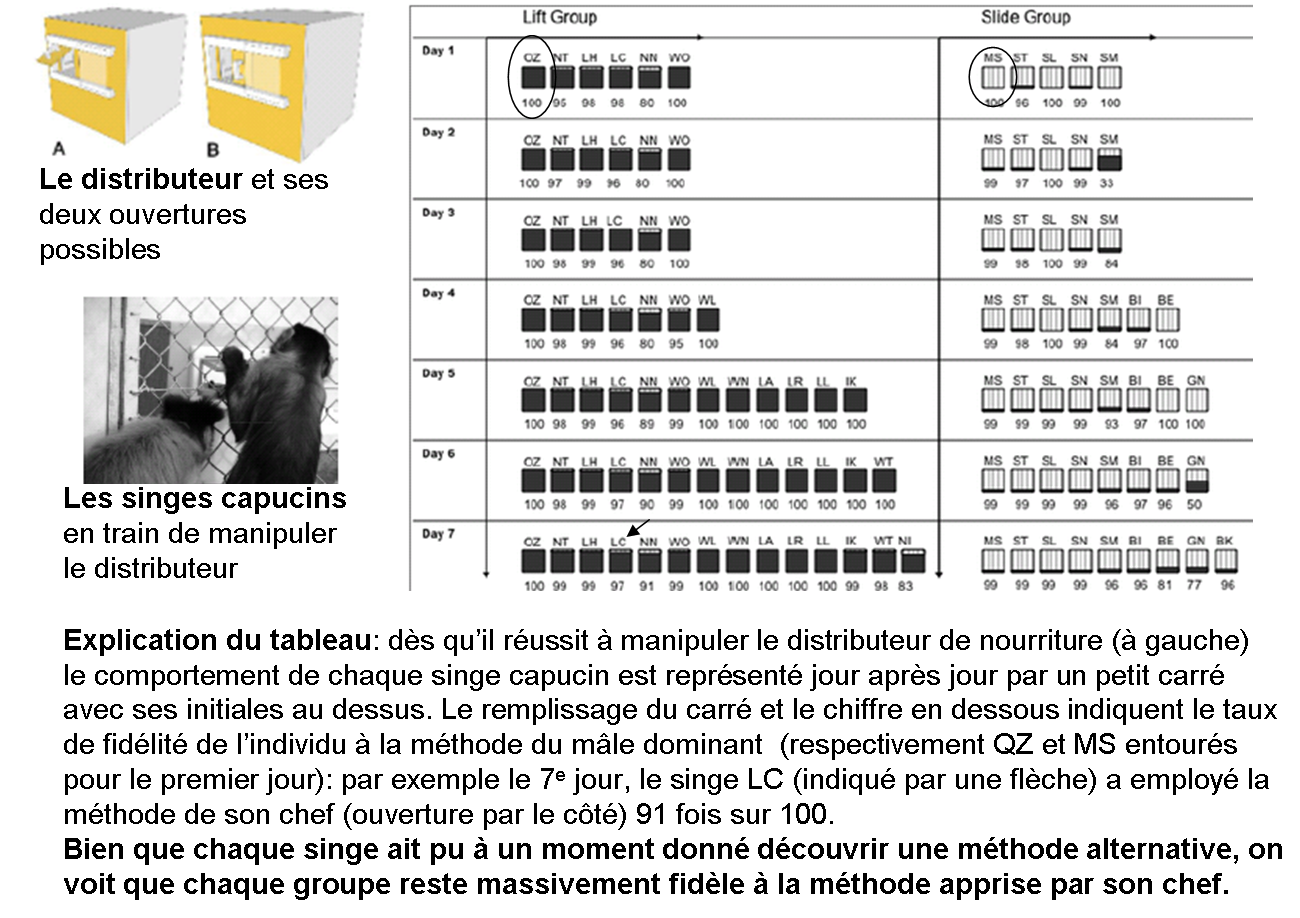
Two dominant males were trained to operate a food dispenser, each by a different method (either by sliding or lifting a lever). We then replaced them with distributors within the clan. Within each clan other capuchins quickly learned to use the dispenser, but while most found the second method of operation, the vast majority just use the same method as the head (any similarity with humans ...)
customs and lifestyle of chimpanzees
With this great example of cultural conformity, reproduced successfully on chimpanzees, we would finally start long sought evidence that monkeys imitate them know. In reality, those who study animals in the field rather than laboratory have known for a long time. As recalled Pracontal, the comparison between the habits of chimpanzees in Tanzania and Guinea (mapping of the left source pdf) is telling: "A Bossou, Guinea when two adult females occur after been separated for some time, they are mutually genital touch. It's not sexual, it is a form of greeting, but it is specific to this site and did not practice at Mahale [Tanzania]. A Bossou to attract a female, a male pat on a branch with his heel, which produces a hit. At Mahale, the gesture is different, made with the sole (...) At Mahale, the power is removed with a leaf. At Taï, chimpanzees used his index and overwrites the parasite on his forearm and not his hand [as at Bossou]. These behaviors that we underestimated the importance is much more common as technological inventions that have taken center stage animal cultures. According to Nakamura and Nishida, these small gestures are the cement cultural group. Their subtle changes have no functional utility, but they define the identity of group. And demonstrate its unique history. "
This observation raises a question that does not Pracontal: why in these conditions cultural behavior of chimpanzees have they stayed so frustrated? Why are these monkeys also show an extraordinary intelligence have they failed to accumulate innovations, sophisticated in their rituals?
limits of imitation in chimpanzees
Nobody really clear answer to this question but it still seems that the capacity for imitation chimpanzees is both more limited and less used than humans. For example, in experience of 1993 it was shown captive chimpanzees how to retrieve food from outside their cage with a rake with the teeth facing up . Chimpanzees have tried to use the rake but not necessarily in the right direction, while young children are reached easily from the age of two years. Chimpanzees thus appear capable of observing a model, to link an object, movement and a result - this would explain the results obtained with the Capuchins, but they have more difficulty in imitating the exact details of the action when it is more difficult. In other words they focus on profit rather than on the process.
This limit is dramatically demonstrated in an experiment to fame: it shows a chimpanzee (or a young child) how to get out a reward of a box (either opaque or transparent) by all kinds of actions on the box, some useful and others not.
- When the box is opaque, one can not distinguish which actions are useful or not. Chimpanzees remake the complete sequence of actions to obtain reward, as well as humans. Proof once again that the chimpanzee known observational imitate simple movements.
- By cons, when the box is transparent and you see what actions are manifestly unnecessary, children remake anyway all the shares of the adult model, whereas chimpanzees skip unnecessary steps.
Upon s think nt understand how it works, the chimpanzee s s s ceases to imitate the process with accuracy and s research nt the solution their own s . He favors s nt naturally social learning through emulation. Children, however, attach more importance to the intentions and methods and spontaneously imitate their model. It seems extraordinary that rationality in this experiment either side of the animal rather than human, but in this case irrationality human seems at the heart of our ability to innovate, to earn the cultural changes and complicated rites. Copy "stupidly" Is it proper to man and the condition of his extraordinary creativity?
Sources:
Michel Pracontal "Kaluchua" (2010)
Cultural evolution , the excellent course at the University Sussex
Related posts:
Darwin reloaded 3 : a first post on the habits and customs animal
Subscribe to:
Posts (Atom)